European business leaders contend with energy shock, with diminishing confidence in swift delivery of Single Market agenda
Brussels, 5 June 2026: Mounting geopolitical risks, weakening economic expectations and persistent concerns about Europe’s long-term business conditions continue to erode confidence among Europe’s top business leaders according to the latest The Conference Board Measure of CEO Confidence™ for Europe by ERT.
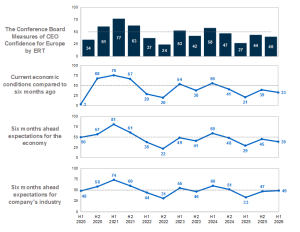
The survey of the 57 CEOs and Chairs of Europe’s leading multinational firms making up the membership of the ERT was conducted in late April. Its results show confidence declining further compared to an already negative level six months ago, the fourth consecutive survey below the neutral threshold of 50. Notably, two-thirds of respondents say that current economic conditions are worse than six months ago and more than half expect them to deteriorate further in the next six months.
This sustained two-year period of negative confidence is unprecedented in the history of the measure, reflecting rising pessimism about both current conditions and the near-term outlook.
1
He added
2
Economic outlook deteriorates while risks intensify
Expectations for economic conditions over the next six months fell sharply, while assessments of current conditions reached particularly weak levels.
At the same time, energy insecurity has emerged as the top geopolitical risk, alongside growing concerns about fragmentation of global markets, insecure trade routes and the weaponisation of critical raw materials.
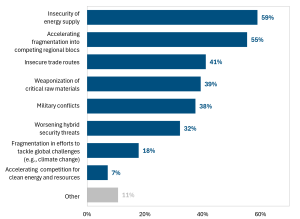
The ongoing war in the Middle East is compounding these pressures: nearly three-quarters of CEOs report a negative impact on near-term business prospects, prompting primarily tactical responses focused on cost management and supply chain resilience.
3
Weak European outlook contrasts with stronger prospects abroad
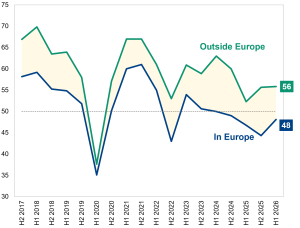
While business expectations in Europe have improved modestly, they remain below neutral and continue to lag behind conditions outside the continent.
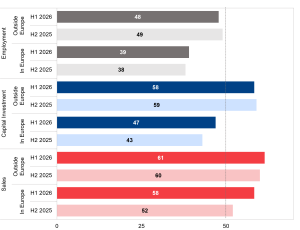
Sales expectations are a notable exception, showing a recovery to their highest level since 2021. However, employment and investment (despite some improvement) projections remain subdued, with many companies anticipating workforce reductions and limited capital expenditure in Europe.
Long-term pessimism about Europe’s competitiveness, doubts on Single Market
Looking further ahead, CEOs express clear concern about Europe’s structural outlook. A key driver of this pessimism is the perceived lack of progress in completing the Single Market: 65% of respondents do not expect it to be completed by 2030.
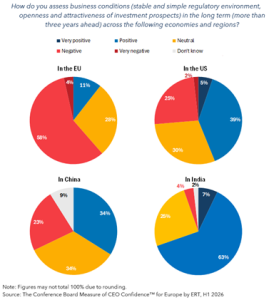
A significant share holds negative views on long-term business conditions in Greater Europe and the EU, with CEOs especially pessimistic about the UK. In contrast, they identify India as the clearest long-term bright spot globally, alongside a moderately positive outlook for US and China.
Global partnerships seen as essential
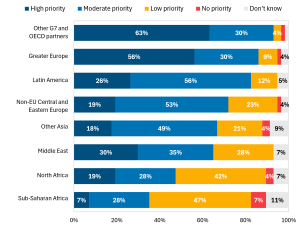
Despite geopolitical fragmentation, European business leaders highlight the importance of strong international partnerships. Beyond advanced economies, India emerges as priority partner for the ERT Members, over the US and China, reflecting its strategic importance and stronger perceived growth prospects.
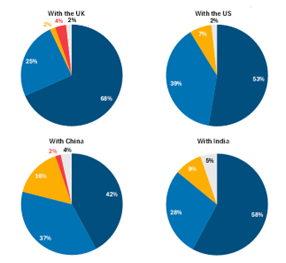
Despite the gloom surrounding long-term business conditions, almost 70% of CEOs believe the EU should give high priority to deepening its strategic relationship with the UK.
Looking ahead, what priority should the EU give to building or deepening strategic relationships with the following economies and regions? (By “strategic relationships” we mean sustained cooperation across areas such as trade and investment, supply chains, technology, security, and climate/energy)
Sara Murray, Managing Director, International at The Conference Board, said, “CEO confidence in Europe has now been negative for two years, sending a clear warning signal for the region’s business outlook. Europe-based companies remain more upbeat about growth prospects outside Europe than at home. There are some counterpoints: sales expectations in Europe have improved, and investment confidence in Europe is now close to neutral. But the wider picture remains worrying, especially on employment, where CEOs continue to take a sharply negative view of prospects in Europe.”
The full report by the Conference Board can be downloaded here.
************
• The measure is based on a survey of the Membership of ERT: 57 CEOs and Chairs of major European multinational companies, representing a 98% response rate.
• A reading below 50 indicates more negative than positive sentiment.
• The survey was conducted between 10 and 30 April 2026.
About the survey
The Conference Board Europe and ERT have collaborated on a Measure of CEO Confidence™ for Europe since 2020. The semi-annual surveys poll the Members of the European Round Table for Industry (ERT) – the CEOs and Chairs of some leading European industrial and technology companies with operations worldwide.
The measure is based on results from three survey questions about: 1) business and economic conditions now; 2) conditions in six months; and 3) prospects for respondents’ own industries. These questions have been asked by The Conference Board in an equivalent survey in the United States on a quarterly basis since 1976. The survey is conducted twice a year in both Europe and China.
In addition to the confidence measure, CEOs and Chairs also assess the outlook for their own company through questions about employment, sales, and capital investment, inside and outside Europe. ERT has fielded these survey questions since the second half of 2017. Special questions of current significance are included in each survey. The response rate to this latest survey was 98%.
For additional information regarding the methodology for The Conference Board Measure of CEO Confidence™ for Europe by ERT, see Surging Confidence Among European Business Leaders Despite Strains on Supply Chains. To view interactive charts with this data, please visit the CEO Confidence Dashboard and to request historical data, please contact the author at afiorito@tcb.org
About ERT
The European Round Table for Industry (ERT) brings together around 60 Chief Executives and Chairs of major multinational companies of European parentage, covering a wide range of industrial and technological sectors. ERT strives for a strong, open, and competitive Europe as a driver for inclusive growth and sustainable prosperity. Companies led by the Members of ERT have operations worldwide, with combined revenues exceeding €3 trillion, providing around 6 million direct jobs worldwide – of which half are in Europe – and sustaining millions of indirect jobs. They invest more than €120 billion annually in R&D, largely in Europe. Members lead companies headquartered in the European Union, Norway, Switzerland and the UK.
About The Conference Board
The Conference Board is the Member-driven think tank that delivers Trusted Insights for What’s Ahead®. Founded in 1916, we are a nonpartisan, not-for-profit organization holding 501 (c) (3) tax-exempt status in the United States. TCB.org l Learn about Membership
The fact that CEO confidence has remained negative for such a prolonged period is unusual and concerning. More than that, it reflects a worrying shift from cyclical slowdown to structural drift. After years of analysis and debate, European business leaders expect delivery: a fully functioning Single Market, a stronger competitiveness agenda, and a stable energy framework.
The priorities are not in question - execution is where the challenge lies. With alignment emerging between the EU institutions, there is a real chance to make progress, but it is a tight window of opportunity. The second half of this year will be mission critical. We hope that the Irish government’s ambitious plans for its Presidency of the EU will yield a breakthrough on the Single Market and ERT stands ready to provide its support.
Energy insecurity is the number one geopolitical risk for companies in Europe. To compete they need to secure reliable, affordable energy. This requires that Europe accelerate efforts to create and complete the Single Market in Energy, supported by a Union based on integration, regulatory coherence, essential long-term investments and the removal of all barriers and obstacles.