Europe risks falling further behind in the race for innovation investment & talent, warns ERT
ERT backs new policy priorities to urgently restore Europe as first choice for investment in innovation and talent.
Brussels, 14 September 2026: A new ERT study out today examines the disparity between Europe’s historic culture of innovation and its underperformance at attracting investment and commercialising and scaling its best ideas. Industrial clusters located throughout Europe are the beating hearts of innovation and they remain powerful engines of growth, technological leadership and industrial transformation. Yet, the study reveals how and why they are not achieving the same degree of innovation, scale and growth as global competitors.
The challenge is already all-too-visible in R&D investment flows. While Europe’s share of global R&D investment has stagnated, corporate R&D expenditure in the United States grew from roughly $540 billion in 2020 to almost $800 billion in 2024*. Over the past two years, East Asia’s leading innovation economies have attracted more than $100 billion** in new greenfield investment commitments in semiconductors, digital infrastructure, advanced manufacturing and other frontier technologies. The race to attract world class talent is also intensifying, as evidenced by Canada’s recent success in attracting 64 top researchers° from the US and elsewhere. These trends clearly underline the increasingly intensity of the global competition for innovation leadership.
The study, entitled Europe Can’t Wait: Building Flagship Innovation Clusters to Restore Competitiveness, finds that Europe’s established clusters are losing out, weakened by fragmented markets, slow regulatory processes, barriers to talent mobility, and intense global competition. Moreover, it warns that while established European sites can be resilient, the loss of reinvestment in next-generation technologies can become difficult and costly to reverse. Europe must therefore strengthen the conditions that attract new R&D, production, talent and capital, rather than just relying on the legacy of existing assets.
1
2
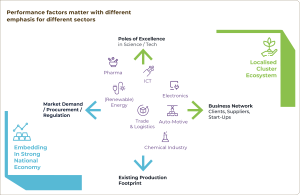
The study examines cluster dynamics across pharmaceuticals, information and communication technologies, automotive, energy, chemicals, trade and logistics, and presents European case studies. It argues that successful clusters combine scientific excellence, dense business networks, existing production strengths and market conditions that reward innovation, while also empowering scale-up.
Performance factors matter with different emphasis for different sectors
Four priorities for action
ERT calls on European and national policymakers to:
- Create integrated markets and coherent regulatory and intellectual property environments, including an effective Fifth Freedom for research, knowledge and talent, and an “approve once, sell everywhere” approach.
- Deepen capital markets and funding for scale-ups, accelerate the Savings and Investment Union and expand public-private co-investment.
- Attract and enable the free flow of top talent through simpler mobility, portable benefits and a fast, unified EU talent visa.
- Strengthen public-private alignment by designating a limited number of flagship clusters, securing long-term support and mobilising serious industry co-investment.
Download the study here.
Background
Based on expert interviews with senior innovation executives across sectors and an extensive literature review, the study was developed through ERT’s Committee for R&D, Innovation & Skills in collaboration with Fraunhofer ISI.
With its 60-strong membership of CEOs and Chairs of some of Europe’s most significant industrial and technology companies operating worldwide, the European Round Table for Industry is uniquely well-placed to bring an informed, high-level, cross-sectoral view of innovation, as a primary pillar of European competitiveness.
ENDS
Note to Editors:
*sources: U.S. National Science Foundation, National Center for Science and Engineering Statistics (NCSES), Business Enterprise Research and Development Survey (BERD); OECD Main Science and Technology Indicators (MSTI). Business R&D performed in the United States increased from $537.6 billion in 2020 to $721.8 billion in 2023, with OECD data indicating approximately $781.6 billion in 2024.
**sources: JETRO (fDi Markets), MOTIE Korea, and UNCTAD greenfield investment data
° source: BBC news
A full list of the Membership of ERT is accessible here.
Europe’s historic excellence in scientific advancement established strong foundations, but it needs to keep up with global competitors offering the right frameworks for the continued generation of breakthroughs in innovation. Increasingly, next-generation R&D investments are flowing to countries outside Europe and that is why we need faster-moving markets, deeper pools of capital, and to attract the world’s best talent.
Sovereignty starts with competitiveness. The race for innovation is now a race for scale, and scale is what Europe needs. The research, the talent and the industrial depth are already here. Companies must now be able to grow, raise capital, partner, and compete globally. That is how the next global success stories will get built and scaled in Europe.