European investment outlook strengthens in latest survey, as CEO Confidence rises
CEO Confidence reaches highest level since H2 2024 and nears neutral.
Brussels, 27 November 2026: A new report out today reveals that European business leaders are becoming less cautious about investing in Europe, with 23% reporting upward revisions to their investment plans, almost three times the share recorded in 2025. Capital investment expectations have also turned positive for the first time since the first half of 2024, according to The Conference Board Measure of CEO Confidence™ for Europe by ERT.
Europe retains a particular advantage in research and development. ERT’s 60 strong Membership – the CEOs and Chairs of Europe’s largest industrial and technology companies – expect the region to receive 57% of their companies’ planned R&D investments over the next three years. This includes 46% in the EU-27, compared with 40% of investment in developing or expanding wider operations (31% in the EU-27).
The findings suggest that Europe may be beginning to reverse the deterioration in business confidence, but it continues to face strong competition as an investment destination. Overall business expectations remain stronger outside Europe, with the US and India attracting the strongest investment intentions.
1
A snapshot of the outlook for business investment in Europe
An uptick in confidence, albeit from a low base: After a sustained period of gloom, CEO Confidence has climbed closer to neutral levels, despite continued energy cost pressures, with improvements explained by better economic conditions. With a neutral level of 50, the index rose to 47, from 40 six months ago. Better assessments of economic expectations also drove the recovery, while industry expectations held around neutral.
Signals of recovery: The recovery in companies’ European business prospects is extending to investment and employment. Capital investment expectations rose and turned positive in Europe for the first time since H1 2024, reversing a negative trend that started in 2022. Sales prospects remain positive both within and outside the continent, and the employment outlook has improved but stayed below neutral in Europe. Nevertheless, overall business expectations remain stronger outside the continent.
Alejandro Fiorito, The Conference Board Economist, noted “The recovery in CEO confidence is driven mainly by improving assessments of current economic conditions, indicating that 2026 has been a year of business and macroeconomic resilience in Europe. However, confidence remains below neutral, and sustained optimism is unlikely until price and cost pressures ease, consumer confidence recovers, and political uncertainties are resolved. 2027 should bring answers to many of these difficult questions, and while the outlook remains cloudy, this report suggests a stronger foundation than previously expected.”
Capital investment prospects improved globally as investment in Europe reversed a negative trend
Over the next six months, what do you expect will
happen with your company’s capital investment?
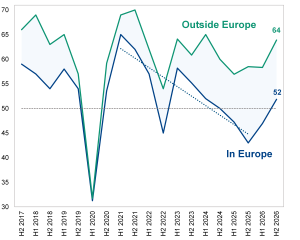
Note: A reading above 50 denotes more positive than negative responses. Dotted line represents the linear trend between H1 2021 and H2 2025.
Source: The Conference Board Measure of CEO Confidence™ for Europe by ERT, H2 2026
CEOs’ confidence for Europe recovered but remained below neutral, with economic conditions and expectations improving substantially and industry expectations remaining around neutral
Evolution of The Conference Board Measure of CEO Confidence™ for Europe by ERT
and its subcomponents
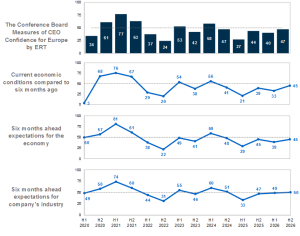
Note: A reading below 50 denotes more negative than positive responses.
Source: The Conference Board Measure of CEO Confidence™ for Europe by ERT, H2 2026
CEOs highlight fragmented defence procurement as key constraint
Over half of CEOs (56%) are either actively supplying defence and dual-use markets or exploring entry, and 43% identify that fragmented national procurement and domestic preferences are the main obstacle to entering or expanding their companies access to these markets. No other option was selected by more than 15% of respondents.
How should AI be regulated?
When asked about international cooperation on advanced AI, CEOs are broadly supportive, while preferring a governance model that preserves national enforcement.
A large majority of CEOs support international cooperation on advanced AI: 55% favour aligned national rules, safety standards and evaluation systems, while retaining national enforcement. A further 28% support binding international rules and an international oversight body. Only 8% believe international cooperation is unlikely to succeed and should thus not be pursued.
This H2 2026 survey was conducted by The Conference Board between 19-30 October 2026 and received a 93% response rate from ERT’s 60-strong Membership. The full report by The Conference Board can be downloaded by the link above.
About the survey
The Conference Board Europe and ERT have collaborated on a Measure of CEO Confidence™ for Europe since 2020. The semi-annual surveys poll the Members of the European Round Table for Industry (ERT) – the CEOs and Chairs of some leading European industrial and technology companies with operations worldwide.
The measure is based on results from three survey questions about: 1) business and economic conditions now; 2) conditions in six months; and 3) prospects for respondents’ own industries. These questions have been asked by The Conference Board in an equivalent survey in the United States on a quarterly basis since 1976. The survey is conducted twice a year in Europe and twice yearly in China.
In addition to the confidence measure, CEOs and Chairs also assess the outlook for their own company through questions about employment, sales, and capital investment, inside and outside Europe. ERT has fielded these survey questions since the second half of 2017. Special questions of current significance are included in each survey. The response rate was 93%.
These latest survey results tell us that Europe has stopped losing ground quite as quickly, but it has not yet regained its competitive edge. The good news is that caution is easing. The appetite and opportunity are there: companies want to invest, innovate and grow in Europe. The test now is whether national governments across the EU-27 can execute the political commitments on simplification, make Single Market integration a reality and deliver a further boost to business confidence.